


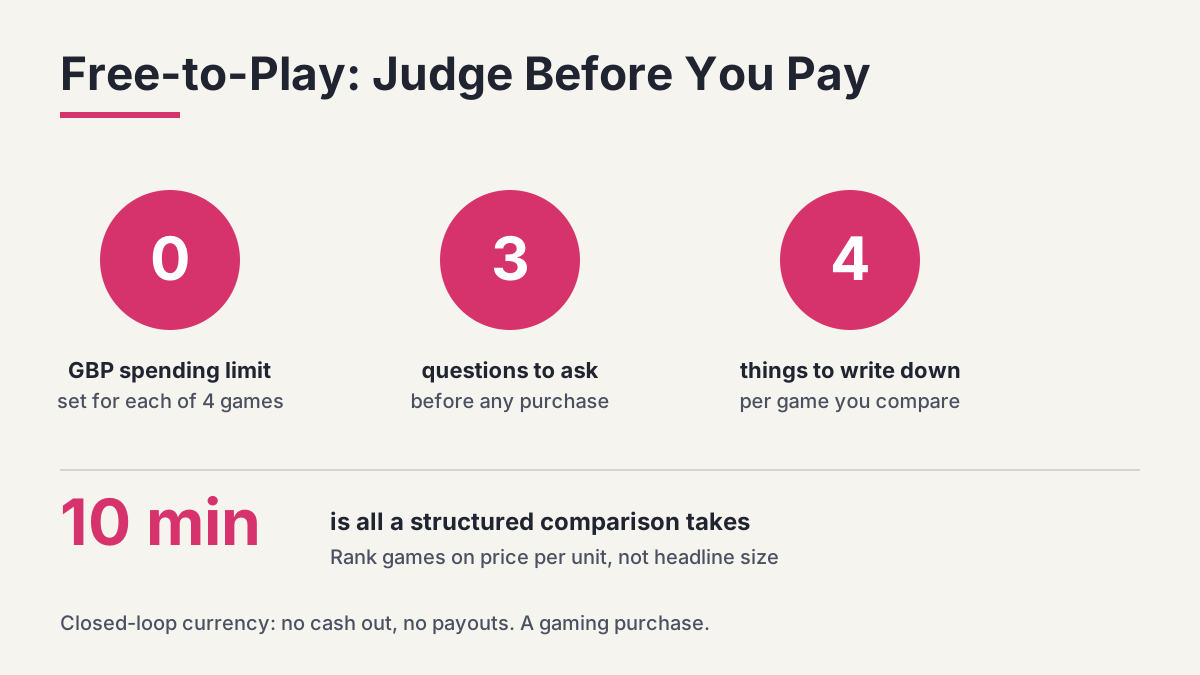
On a Tuesday in March, I opened four adult free-to-play games in a row and set a spending limit of 0 GBP for each. Most of these games cost nothing to download, and that limit is a perfectly good plan. The real question is narrower: when does a currency pack earn its price? For a casual player the answer is usually "rarely", and for a collector who wants specific cosmetics it is "sometimes". Before comparing titles, it helps to be clear about what you are actually buying, because these games are gaming products, not gambling. There are no real-money stakes, no winnings, and no payouts or withdrawals. Money goes in, content comes out, and nothing ever comes back as cash.
What you are actually paying for
The mechanic is the same across the genre. You buy a closed-loop in-game currency with real money, then spend it on unlocks inside one game. Typical unlocks are cosmetic outfits, extra scenes, faster progression and small conveniences such as skipping a timer. The currency cannot be withdrawn, sold or converted to money, and it has no value outside the game. That is why a purchase here is a digital consumer purchase, not a bet.
Take Pornstar Harem as a concrete example. It is an 18+ browser game where you play a hero who collects girls into a Harem, gains experience and moves through the story. It runs in the browser, installs as a progressive web app, and needs no app store download. The premium currency in the Hentai Heroes game family is called Kobans, and money is only spent on optional in-game purchases. Clear.
Judge any title in this genre by three questions. What does the currency unlock? Can the same thing be earned by playing? And is the price shown in pounds before checkout? If all three answers are good, buying becomes a reasonable choice rather than a nudge. If any answer is vague, treat that as the signal to wait. Optional.
How to compare titles before you spend
A structured comparison beats a gut feeling, and it takes about ten minutes. Open each game, play the free route for a session or two, and write down four things: what the first currency pack costs, how much of it a typical item eats, how fast free currency arrives, and whether paid items are cosmetic or affect progression. Then rank the games on price per unit, not on the size of the headline number, because bundle labels can hide poor value.
| What to check | Good sign | Warning sign |
|---|---|---|
| What the currency buys | Cosmetics, extra scenes, convenience | Core gameplay locked behind payment |
| Free earn path | Daily rewards that cover small unlocks | Free currency so slow it feels like a wall |
| Price display | Pounds shown before checkout | Hidden conversion rates, confusing bundles |
| Purchase prompts | Rare, easy to dismiss | Countdown timers and repeated pop-ups |
Use the table as a scorecard. A game that scores well on the left column is one you can enjoy for months at zero cost and dip into once in a while. A game that scores badly on the right column is not necessarily bad, but it is designed to make you spend sooner than you planned. Know which kind you have opened.
A week on the Northern line
Last summer I spent a week with two mobile titles on my commute, roughly thirty minutes each way on the Northern line. I wanted to know which one justified its premium currency pricing for a casual player. One offered a generous daily bonus that made optional spending easy to ignore. The other pushed a limited-time bundle every few days, with a countdown I could not miss on a crowded carriage.
I noticed the difference on the third morning, when I caught myself doing sums on the platform at Camden Town. The first game never made me feel I was missing out, so my spend stayed at nothing for the whole week. The second had me comparing a bundle price against the single cosmetic I actually wanted, and I put my phone away annoyed. I skipped the bundle and bought nothing. The cheaper path was the smarter starting point: buy the one item you want, not the pack that looks biggest.
Cosmetic spending versus progression spending
The most useful split is between what changes how your game looks and what changes how fast it moves. Cosmetic purchases are the easiest to defend. They add something you enjoy, they do not affect anyone else, and skipping them costs you nothing in the core experience. Extra scenes and story content sit in a similar bucket, because you decide in advance whether the content is worth its price.
Progression spending is harder to judge. Paying to skip a timer or speed up unlocks buys convenience, and that is fair if your time is tight, but it can quietly become a habit. A sound rule from the wider genre is that core gameplay should never be gated behind payment alone, and a free alternative should exist for any time-limited unlock. Test this yourself by playing a week without paying. If you can still progress and enjoy it, the free route is complete enough, and any purchase is a bonus rather than a requirement.
In Pornstar Harem, for instance, Clubs unlock once you have 15 girls in your Harem, and you can then create or join a Club and use Club Chat. That feature comes from playing, not paying. Features gated by progress rather than by price are a good sign, and they are worth noting when you compare titles.
The real downsides to weigh
Spending has drawbacks, and a fair look has to name them. The first is pricing clarity. Bundles and currency conversions can be hard to compare, so a pack that looks generous may cost more per unit than a smaller one. Always divide the price by the amount of currency before you decide.
The second is pressure mechanics. Countdown timers and repeated prompts exist to push a decision, and I found them far more tiring than the price itself. The third is refunds. Store refund routes can be slow or unclear, so assume that a purchase is final the moment you tap confirm. A fourth point is data: adult titles collect account details, device information and purchase records, so read the privacy policy and check you can delete your account. None of these is a reason to avoid the genre. They are reasons to set limits before you open the shop, not after.
A simple spending rule
Set a monthly cap in pounds before you buy anything, and stick to it. A cap of 5 GBP or 10 GBP is enough to unlock a few cosmetics without turning a hobby into a bill. Then apply a waiting rule: when a bundle tempts you, wait 48 hours. If you still want the item after two days, buy it. If the urge has gone, you saved the money and lost nothing.
Payment channel matters too. Card payments, digital wallets and store billing each have their own refund rules, and the receipt is your record if something goes wrong. Keep it. Check that the total shown at checkout matches what you expected, because accidental purchases usually come from a confirmation step that was too easy to skip. These habits cost nothing and work in every game in this genre.
Age limits and safe use
These games are strictly for adults aged 18 and over. Reputable titles apply an age gate before mature content loads and state clearly that the game is for adults. In the UK, rules on age checks for adult content continue to tighten, so expect more verification over time rather than less. If you share a device, use a separate profile and keep payment details off it, so that nobody else can make purchases by accident.
The currency has no cash value and there are no payouts, so there is no financial upside to chase, and that should shape your expectations. You are paying for entertainment, the same way you would pay for a film or a console game. Before you close this page, open the purchase history of the game you play most and write down what you spent in the last 30 days. Is that number lower than the cap you would set today? If not, pick the cap now and put it in your phone's notes.
Comments
No comments yet.
Leave a comment
Your email will not be shown. Comments are reviewed before they appear.